Date:
September 15/16, 18/19/20 - 2025
•
Exposure:
138 x 5 minutes Halpha (11hrs 30mins)
269 x 3 minutes RGB (13hrs 27mins)
Total: 24hr 57min
About This Image
Gear:
Telescope: Stellarvue SVX130T-R
Mount: Software Bisque Paramount MYT
Camera: Player One Poseidon-C Pro • Player One Poseidon-M Pro
Filter: Optolong L-Quad • Antlia Edge 4.5nm Ha
Accessories: 3.5" Feathertouch • Stellarvue SFFRX-130140
Guiding: Player One FHD-OAG MAX • Player One Ceres-462M • PHD2
Software: Photoshop • PixInsight • TheSkyX • Starkeeper Voyager
Description:
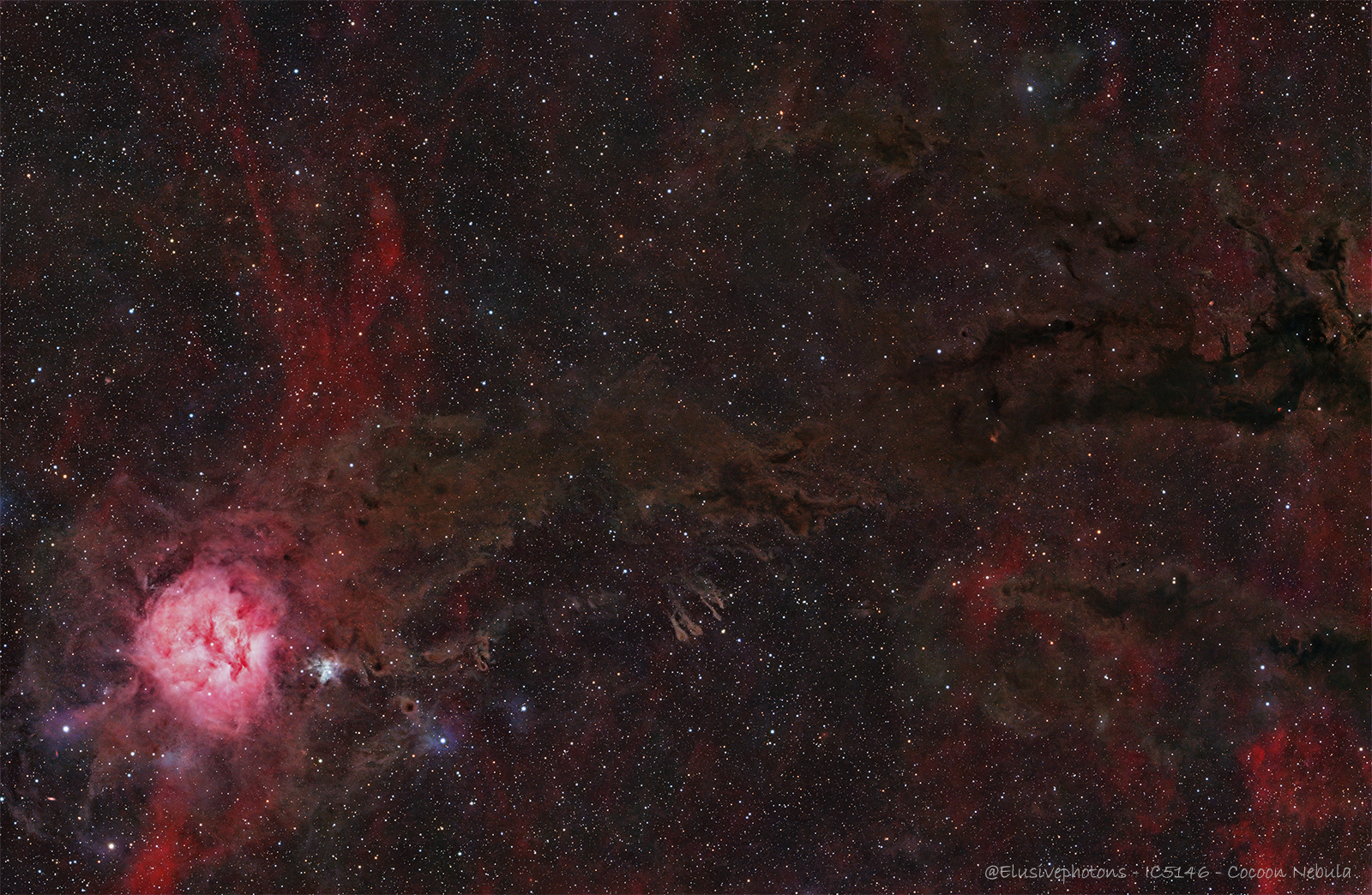
The Cocoon Nebula, catalogued as IC 5146, hangs in the northern constellation Cygnus as a compact cradle of starbirth wrapped in a sheath of dust and gas. It spans roughly 15 light-years across, with angular measurements of about 12 arcminutes translating to this true diameter, and lies on the order of 3,000 - 4,000 light-years from Earth, placing it comfortably within our Milky Way's spiral arms. Through long-exposure imaging, the nebula appears as a glowing red-pink sphere embedded at the end of a dark lane of dust (Barnard 168), creating the impression of a luminous cocoon trailing a smoky celestial tail across the sky.
At the heart of this nebula sits a hot, massive B-type main-sequence star, identified as BD +46deg 3474, only about 100,000 years old - an infant by stellar standards. Its intense ultraviolet radiation ionizes the surrounding hydrogen, producing the characteristic H II region glow, while nearby dust both scatters starlight to form a reflection nebula and blocks background stars to create striking dark patches. This interplay of emission, reflection, and dark nebula components makes IC 5146 a textbook example of how massive young stars reshape the very clouds from which they formed, carving out a cavity in the gas and dust around them.
Embedded within and around the glowing gas is the young open cluster Collinder 470, whose members share the nebula's youth and help trace the recent burst of star formation in this region. The surrounding molecular cloud and dark lane are rich with cold, dense material, seeds from which future generations of stars may still condense, ensuring that the Cocoon Nebula remains an active stellar nursery rather than a static celestial ornament. To gaze at IC 5146, whether visually or in deep images, is to witness a dynamic transformation in progress: gravity, radiation, and time conspiring to turn an unremarkable cloud of interstellar matter into a glittering cluster of young suns.
Sources:
[1] en.wikipedia.org/wiki/IC_5146
[2] astrobackyard.com/ic-5164-cocoon-nebula/
[3] theastroenthusiast.com/the-cocoon-nebula-ic-5146/
[4] constellation-guide.com/cocoon-nebula/
[5] deepskycorner.ch/obj/ic5146.en.php
[6] galactic-hunter.com/post/ic-5146-the-cocoon-nebula
[7] arxiv.org/abs/1410.0119
Distance: 4,000 light-years
Size: 15 light-years
|

 Craig Sherris