Date:
August 21,24-28 - 2025
•
Exposure:
103 x 5 minutes Halpha (8hrs 35mins)
332 x 3 minutes RGB (16hrs 36mins)
Total: 25hr 11min
About This Image
Gear:
Telescope: Stellarvue SVX130T-R
Mount: Software Bisque Paramount MYT
Camera: Player One Poseidon-C Pro • Player One Poseidon-M Pro
Filter: Player One IR/UV • Optolong L-Quad • Antlia Edge 5nm Ha
Accessories: 3.5" Feathertouch • Stellarvue SFFX3
Guiding: Player One FHD-OAG MAX • Player One Ceres-462M • PHD2
Software: Photoshop • PixInsight • TheSkyX • Starkeeper Voyager
Description:
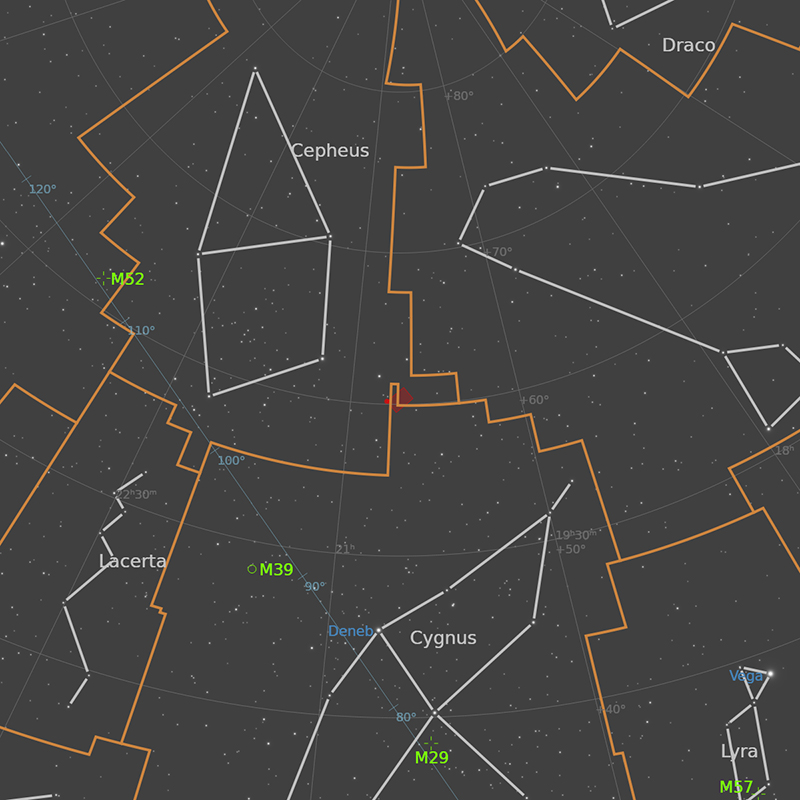
The Fireworks Galaxy, formally known as NGC 6946 (or sometimes M6946 due to historical catalog confusion), is a striking face-on intermediate spiral galaxy located about 22 - 25 million light-years from Earth, straddling the constellations Cepheus and Cygnus. With a diameter near 40,000 to 87,000 light-years depending on how it is measured, it is roughly one-third the size of the Milky Way but is notable for its exceptionally high rate of star formation earning its nickname thanks to the ten supernovae observed in its spiral arms in just the past century. This prolific activity, combined with the presence of star-forming regions and dark dust lanes, makes NGC 6946 a classic example of a starburst galaxy.[1][3][6][7][8]
NGC 6946 is also classified as an intermediate spiral and even as a double-barred spiral in some studies, featuring a bright core likely hosting a black hole and a smaller bar structure channeling gas into the central regions. The galaxy appears faint in visible wavelengths because it lies almost in the plane of our own Milky Way, with interstellar dust reddening its light as it travels to us. The Fireworks Galaxy has become a favorite target not only for professional astronomers but also for astrophotographers due to its rich structure including visible reddish star factories, intricate blue spiral arms, and the golden glow at its core.[3][4][8][1]
One lesser-known and fascinating fact about the Fireworks Galaxy (NGC 6946) is the presence of a mysterious feature called "Hodge's Complex." Discovered in 1967, Hodge's Complex was initially thought to be a young supergiant star cluster within the galaxy, but more recent research in 2017 revealed it is actually an interacting dwarf galaxy superimposed on the disk of NGC 6946. This rare circumstance offers astronomers a unique opportunity to study the processes of galaxy interaction and star formation within a starburst spiral, all in the same field of view.[9][10]
Sources:
[1] en.wikipedia.org/wiki/NGC_6946
[2] guidescope.net/galaxies/ngc6946.htm
[3] astrodoc.ca/ngc6946-ngc6939/
[4] deepskycorner.ch/obj/ngc6946.en.php
[5] astrodoc.ca/ngc-6946/
[6] reddit.com/r/Astronomy/comments/14qfjmq/the_fireworks_galaxy/
[7] facebook.com/groups/zwoasiusers/posts/2553071028385263/
[8] esahubble.org/images/potw2101a/
[9] theplanets.org/galaxies/fireworks-galaxy/)
[10] en.wikipedia.org/wiki/NGC_6946)
Distance: 22-25 Million light-years
Size: 87,000 light-years
| 


 Craig Sherris